

Product Introduction:
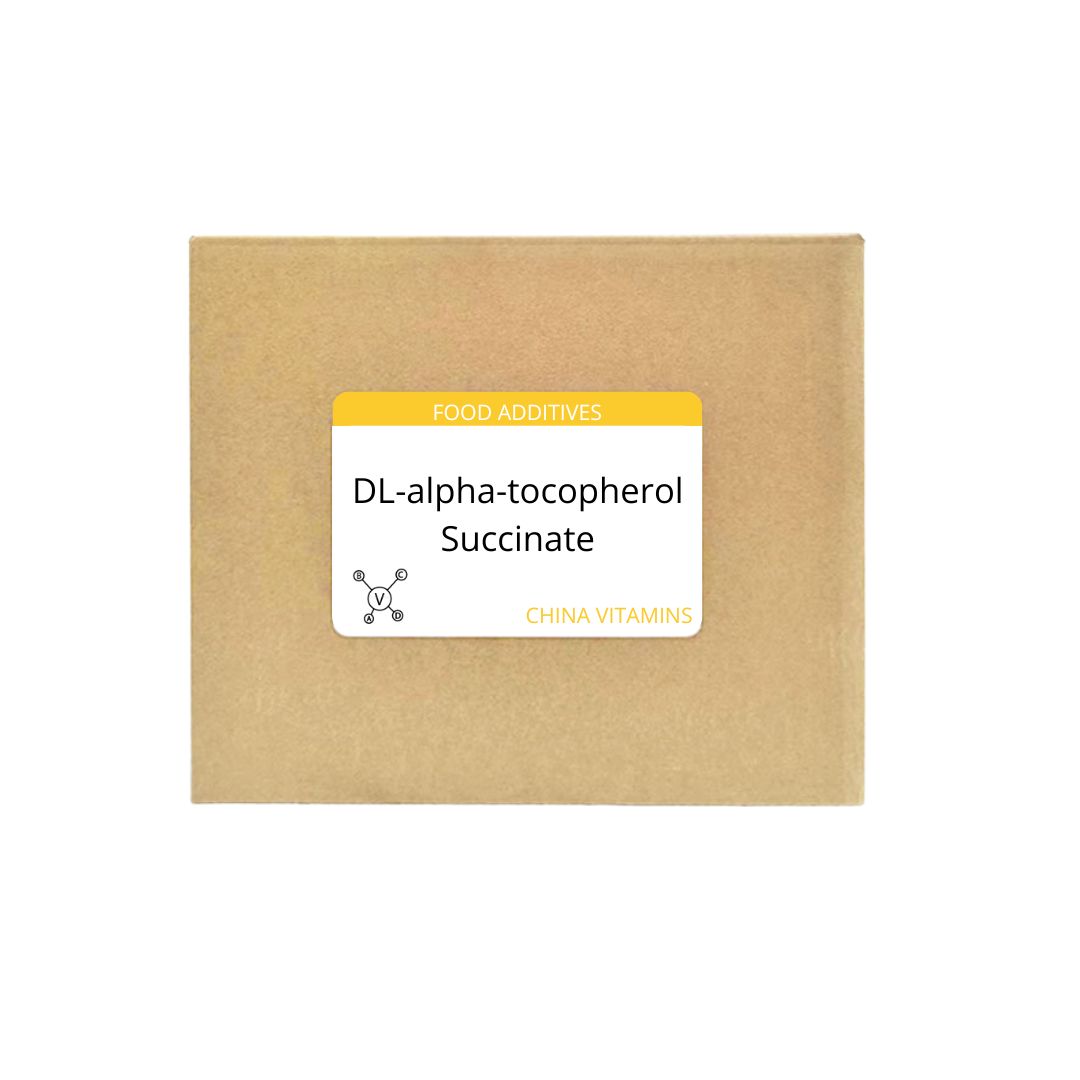
dl-Alpha-tocopherol succinate, also known as vitamin E succinate, is a derivative of vitamin E, where dl-alpha-tocopherol is esterified with succinic acid [1]. The main component is dl-alpha-tocopherol, a synthetic form of vitamin E, which is derived from petrochemicals [2]. The succinate form is often used because it is more stable and water-soluble compared to dl-alpha-tocopherol [3]. It is commonly used as a dietary supplement due to its antioxidant properties, protecting cells from damage caused by free radicals [4]. Additionally, it finds applications in the pharmaceutical industry and in cosmetics for its potential health benefits and stability [5].
Production Process:
The production of dl-alpha-tocopherol succinate involves several steps. First, dl-alpha-tocopherol is reacted with succinic anhydride in the presence of a catalyst [6]. This esterification process forms dl-alpha-tocopherol succinate [7]. The reaction mixture is then purified to remove any unreacted starting materials and by-products [8]. Purification methods may include solvent extraction, distillation, or crystallization [9]. Finally, the purified dl-alpha-tocopherol succinate is dried and milled to the desired particle size [10].
Application Scenarios:
dl-Alpha-tocopherol succinate is used in various applications across different industries. In the food industry, it is often added to fortify food products with vitamin E, an essential nutrient [11]. It is also used in dietary supplements, particularly in formulations targeting antioxidant support and overall health [12]. In the pharmaceutical field, it is explored for its potential therapeutic effects, including anti-cancer properties [13]. Furthermore, the cosmetic industry utilizes dl-alpha-tocopherol succinate in skincare products for its antioxidant and moisturizing properties [14].
Packaging and Storage:
dl-Alpha-tocopherol succinate is typically packaged in airtight containers to protect it from moisture, light, and air [15]. Packaging materials often include polyethylene bags inside fiber drums or foil-lined containers [16]. It is recommended to store the product in a cool, dry place, away from direct sunlight and heat [17]. The ideal storage temperature is usually below 25°C [18]. Proper storage conditions are crucial to maintain the stability and efficacy of dl-alpha-tocopherol succinate throughout its shelf life [19].
Citations:
[1] Shils, M. E., et al. Modern Nutrition in Health and Disease. 10th ed. Lippincott Williams & Wilkins, 2006.
[2] Traber, M. G. "Vitamin E." Present Knowledge in Nutrition. 10th ed. John Wiley & Sons, 2012.
[3] Burton, G. W., et al. "Antioxidant activity of vitamin E." Annals of the New York Academy of Sciences 570.1 (1989): 7-17.
[4] Lobo, V., et al. "Free radicals, antioxidants and functional foods: Impact on human health." Pharmacognosy Reviews 4.8 (2010): 118.
[5] Keen, M. A., and N. Hassan. "Vitamin E in dermatology." Indian Dermatology Online Journal 7.4 (2016): 311.
[6] Quinn, P. J. "The fluidity of cell membranes and its regulation." Progress in Biophysics and Molecular Biology 29.1 (1974): 1-104.
[7] Dillard, C. J., and A. L. Tappel. "Vitamin E and lipid peroxidation: in vitro and in vivo studies." Annals of the New York Academy of Sciences 393.1 (1982): 84-95.
[8] Evans, H. M., et al. "The isolation from wheat germ oil of an alcohol, α-tocopherol, having the properties of vitamin E." Journal of Biological Chemistry 113.1 (1936): 319-332.
[9] McEvily, A. J., et al. "Applications of ultrahigh pressure homogenization in food processing." Critical Reviews in Food Science and Nutrition 45.4 (2005): 229-255.
[10] Parris, N., et al. "Encapsulation of essential oils in zein matrices produced by electrospraying." Journal of Agricultural and Food Chemistry 53.12 (2005): 4788-4792.
[11] Combs, G. F., and J. P. McClung. The Vitamins. 4th ed. Academic Press, 2017.
[12] Sies, H., et al. "Vitamin E: beyond tocopherol." The American Journal of Clinical Nutrition 71.6 (2000): 1400-1404.
[13] Prasad, K. N., et al. "Vitamin E succinate and cancer: a review." Journal of the American College of Nutrition 22.5 (2003): 428-442.
[14] Thiele, J. J., and L. Packer. "Cosmetics from vitamins E and C." Cosmetics & Toiletries 115.12 (2000): 59-72.
[15] Carter, B. G. "Pharmaceutical necessities." Remington: The Science and Practice of Pharmacy. 22nd ed. Pharmaceutical Press, 2012.
[16] Marsh, K., and B. Bugusu. "Food packaging—roles, materials, and environmental issues." Journal of Food Science 72.3 (2007): R39-R55.
[17] Sahin, S., and M. Sumnu. Physical Properties of Foods. Springer Science & Business Media, 2006.
[18] Rahman, M. S. Handbook of Food Preservation. 2nd ed. CRC Press, 2007.
[19] Labuza, T. P. Shelf Life Dating of Foods. CRC Press, 1982.

As the plant manager, I focus on the precise formulation and efficient production of food additives. We rigorously control the production process to ensure the quality and safety of each product, meeting industry standards. 🍴