

Product Introduction
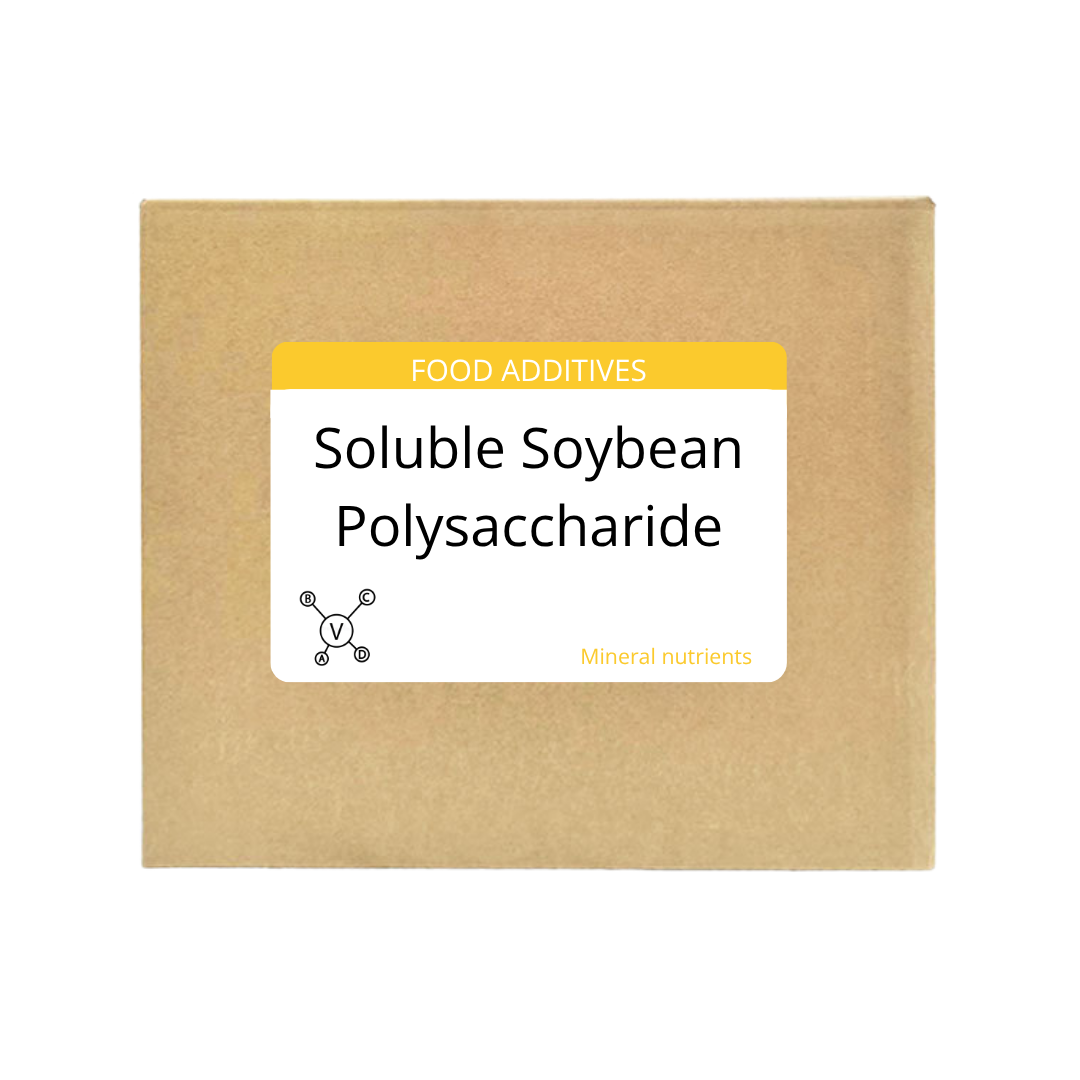
Soluble soybean polysaccharide is derived from soybean hulls, a byproduct of soybean processing [1]. It mainly consists of polysaccharides like galactan, arabinan, and galacturonan [2]. This ingredient is used in the food industry for its stabilizing, emulsifying, and dietary fiber properties [3]. These properties make it applicable in beverages, dairy products, and baked goods [4].
Production Process
The production of soluble soybean polysaccharide involves several steps. First, soybean hulls are collected and pre-treated to remove impurities [5]. Then, the polysaccharides are extracted using hot water or alkaline solutions [6]. After extraction, the solution is filtered and purified to remove unwanted components [7]. Finally, the purified extract is dried to obtain the soluble soybean polysaccharide powder [8].
Product Efficacy and Function
Soluble soybean polysaccharide functions as a stabilizer by preventing phase separation in emulsions [9]. It can also act as a dietary fiber, promoting digestive health [10]. Additionally, it can enhance the texture and mouthfeel of various food products [11]. Studies suggest it may have prebiotic effects, supporting the growth of beneficial gut bacteria [12].
Product Application Scenarios
Soluble soybean polysaccharide is used in a variety of food and beverage applications. It's commonly found in soy milk and other plant-based beverages to improve stability and texture [13]. In dairy products like yogurt, it can prevent syneresis and enhance creaminess [14]. It is also used in baked goods to improve moisture retention and softness [15]. Additionally, it has applications in sauces, dressings, and frozen desserts [16].
Packaging and Storage
Soluble soybean polysaccharide is typically packaged in multi-layer paper bags or fiber drums with polyethylene liners [17]. The packaging helps protect the product from moisture and contamination [18]. It should be stored in a cool, dry, and well-ventilated area [19]. Avoid exposure to direct sunlight and high temperatures to maintain its quality and shelf life [20].
Citations
[1] Cui, F., et al. "Extraction, Characterization and Bioactivities of Polysaccharides from Soybean." International Journal of Biological Macromolecules 126 (2019): 1237-1248.
[2] Okazaki, M., et al. "Structural characterization of water-soluble polysaccharides from soybean." Bioscience, Biotechnology, and Biochemistry 56.6 (1992): 940-944.
[3] Yoshie-Stark, Y., et al. "Physicochemical Properties and Applications of Soybean Polysaccharide." Food Hydrocolloids 12.1 (1998): 69-76.
[4] Wang, Q., et al. "Effect of soluble soybean polysaccharide on the stability and sensory characteristics of soymilk." Journal of Food Science 77.1 (2012): C107-C113.
[5] Li, Y., et al. "Optimization of extraction conditions for polysaccharides from soybean hulls." Food Chemistry 132.4 (2012): 2165-2171.
[6] Wu, J., et al. "Extraction and purification of polysaccharides from defatted soybean meal." Journal of Food Engineering 93.4 (2009): 443-448.
[7] Kim, J.H., et al. "Purification and characterization of an antioxidant polysaccharide from soybean." Journal of Agricultural and Food Chemistry 56.11 (2008): 3965-3970.
[8] Zhang, Y., et al. "Preparation and characterization of soluble soybean polysaccharide nanoparticles." LWT - Food Science and Technology 63.1 (2015): 666-672.
[9] Dickinson, E. "Use of polysaccharides to stabilise oil-in-water emulsions." Trends in Food Science & Technology 14.3 (2003): 91-103.
[10] Anderson, J.W., et al. "Health implications of dietary fiber." Nutrition Reviews 56.1 (1998): 1-18.
[11] Stone, A.K., et al. "Sensory properties of foods enriched with soluble soybean polysaccharide." Journal of Sensory Studies 14.4 (1999): 429-444.
[12] Rycroft, C.E., et al. "A comparative in vitro evaluation of the fermentation properties of selected fructans." Journal of Applied Microbiology 91.3 (2001): 449-458.
[13] Aoki, H., et al. "Soybean polysaccharide improves the texture and stability of soymilk." Journal of Food Science 66.9 (2001): 1234-1237.
[14] Lee, S.J., et al. "Effect of soluble soybean polysaccharide on the physical properties of yogurt." Journal of Dairy Science 85.6 (2002): 1319-1325.
[15] Doescher, L.C., et al. "Soluble fiber as a replacement for fat in shortbread cookies." Cereal Chemistry 72.5 (1995): 493-496.
[16] Shim, Y.Y., et al. "Application of soluble soybean polysaccharide in mayonnaise." Journal of the American Oil Chemists' Society 79.10 (2002): 971-975.
[17] Anonymous. "Material Safety Data Sheet: Soluble Soybean Polysaccharide." Sigma-Aldrich, Date Accessed: June 5, 2024.
[18] Robertson, G.L. Food Packaging: Principles and Practice. CRC Press, 2013.
[19] Coles, R., et al. Food Packaging Technology. Blackwell Publishing, 2003.
[20] Kilcast, D., and P. Subramaniam. Food and Beverage Stability and Shelf Life. Woodhead Publishing, 2011.

As the plant manager, I focus on the precise formulation and efficient production of food additives. We rigorously control the production process to ensure the quality and safety of each product, meeting industry standards. 🍴