

Product Introduction
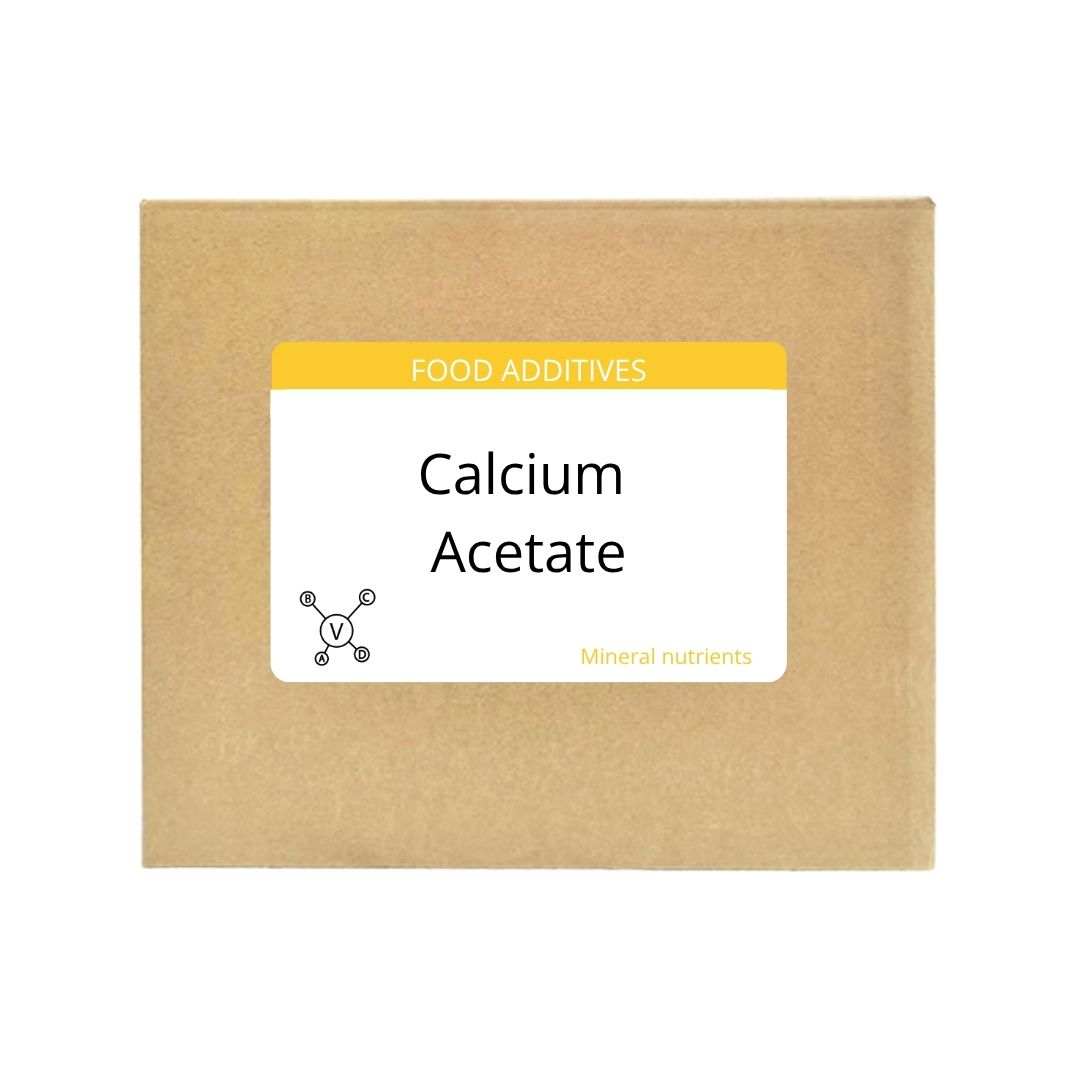
Calcium acetate, with the chemical formula Ca(C2H3O2)2, is a calcium salt of acetic acid. It is also known as acetate of lime. Calcium acetate appears as a white, hygroscopic crystalline powder and has a slightly bitter taste [1]. It is soluble in water, and its solubility increases with temperature [2]. Calcium acetate is used in various applications, including as a food additive, stabilizer, and buffer [3]. It functions as a preservative, buffering agent, and sequestrant in food products [4].
Production Process
Calcium acetate can be produced through several methods. One common method involves reacting acetic acid with calcium carbonate or calcium hydroxide [5]. The reaction between acetic acid and calcium carbonate produces calcium acetate, water, and carbon dioxide [6]. Another method involves reacting calcium oxide with acetic acid [7]. These reactions are typically carried out in aqueous solutions, and the resulting calcium acetate is then isolated through evaporation and crystallization [8]. The final product is dried to obtain the desired crystalline form [9].
Product Functions and Effects
Calcium acetate serves multiple functions in various applications. In the food industry, it acts as a buffering agent, helping to maintain the pH level of food products [10]. It functions as a preservative by inhibiting the growth of microorganisms, thereby extending the shelf life of food [11]. Additionally, it acts as a sequestrant, binding to metal ions and preventing them from causing undesirable changes in food products [12]. Calcium acetate is also used in medicine as a phosphate binder for patients with kidney disease [13]. It helps to control phosphate levels in the blood by binding to dietary phosphate in the gastrointestinal tract [14].
Product Application Scenarios
Calcium acetate is utilized in a variety of application scenarios across different industries. In the food industry, it is added to baked goods, processed foods, and dairy products as a preservative and buffering agent [15]. It is also used in the production of tofu to improve its texture and firmness [16]. In the pharmaceutical industry, calcium acetate is administered to patients with chronic kidney disease to manage hyperphosphatemia [17]. It is available in tablet or capsule form for oral administration [18]. Additionally, calcium acetate finds application in textile dyeing as a mordant, helping to fix dyes onto fabrics [19]. It is also used in the production of calcium-based chemicals and as a stabilizer in certain industrial processes [20].
Packaging and Storage
Calcium acetate should be packaged in airtight containers to prevent moisture absorption, as it is hygroscopic [21]. The containers should be stored in a cool, dry place, away from direct sunlight and incompatible substances [22]. Proper storage conditions help to maintain the quality and stability of the product [23]. Under these conditions, the shelf life of calcium acetate is typically 24 months [24].
Citations
[1] Food Chemicals Codex, 5th ed. Washington, DC: National Academy Press, 2004, p. 74.
[2] Haynes, W.M. (ed.). CRC Handbook of Chemistry and Physics. 95th Edition. CRC Press, Boca Raton, FL 2014-2015, p. 4-55
[3] Food and Drug Administration, 21 CFR 184.1185.
[4]ん Branen, A.L., Davidson, P.M., Salminen, S., & Thorngate, J.J. (Eds.). (2001). Food additives (2nd ed.). Marcel Dekker.
[5] Lewis, R.J. Sr. (ed) Sax's Dangerous Properties of Industrial Materials. 11th Edition. Wiley-Interscience, Wiley & Sons, Inc. Hoboken, NJ. 2004., p. 628
[6] Brown, T. L., LeMay, H. E., Jr., & Bursten, B. E. (2003). Chemistry: The central science (9th ed.). Prentice Hall.
[7] Kirk-Othmer Encyclopedia of Chemical Technology. 4th ed. Volumes 1-27, New York, NY: John Wiley & Sons, 1991-Present., p. V4: 433 (1992)
[8] Seidell, A. Solubilities of Inorganic and Metal Organic Compounds. A Compilation of Solubility Data from the Scientific Literature. Third Edition. Volumes I and II. D. Van Nostrand Company, Inc., New York. 1940., p. V1: 249
[9] O'Neil, M.J. (ed.). The Merck Index - An Encyclopedia of Chemicals, Drugs, and Biologicals. 13th Edition, Whitehouse Station, NJ: Merck and Co., Inc., 2001., p. 274
[10] Potter, N. N., & Hotchkiss, J. H. (1995). Food science (5th ed.). Chapman & Hall.
[11] Davidson, P. M., Sofos, J. N., & Brannen, A. L. (2005). Antimicrobials in foods (3rd ed.). CRC Press.
[12] Nielsen, S. S. (2017). Food analysis (5th ed.). Springer.
[13] National Kidney Foundation. (2012). KDOQI clinical practice guideline for lipid management in chronic kidney disease. American Journal of Kidney Diseases, 60(3), 347-675.
[14] Tonelli, M., Pannu, N., & Manns, B. (2010). Oral phosphate binders in patients with kidney failure. New England Journal of Medicine, 362(14), 1312-1324.
[15] Smit, G. (Ed.). (2003). Dairy processing handbook. Tetra Pak Processing Systems AB.
[16] Lusas, E. W., & Rooney, L. W. (2001). Snack foods processing. CRC Press.
[17] Qunibi, W. Y., Moustafa, M., Muenz, D., Baker, B., & Braden, G. (2002). A 1-year randomized trial of calcium acetate versus sevelamer on progression of coronary and aortic calcification in hemodialysis patients with hyperphosphatemia. American Journal of Kidney Diseases, 40(6), 1225-1235.
[18] KDIGO Clinical Practice Guideline for the Diagnosis, Evaluation, Prevention, and Treatment of Chronic Kidney Disease-Mineral and Bone Disorder (CKD-MBD). Kidney International Supplements, 2009, 113, S1-S130.
[19] Trotman, E. R. (1984). Dyeing and chemical technology of textile fibres (6th ed.). Charles Griffin & Company.
[20] Ullmann's Encyclopedia of Industrial Chemistry. Wiley-VCH, 2000.
[21] United States Pharmacopeial Convention. (2017). United States pharmacopeia (USP 40).
[22] Codex Alimentarius Commission. (1999). Codex general standard for food additives (GSFA).
[23] Fellows, P. J. (2009). Food processing technology: Principles and practice (3rd ed.). Woodhead Publishing.
[24] Food Chemicals Codex, 12th Edition. United States Pharmacopeial Convention. 2020.

As the plant manager, I focus on the precise formulation and efficient production of food additives. We rigorously control the production process to ensure the quality and safety of each product, meeting industry standards. 🍴