

Product Introduction
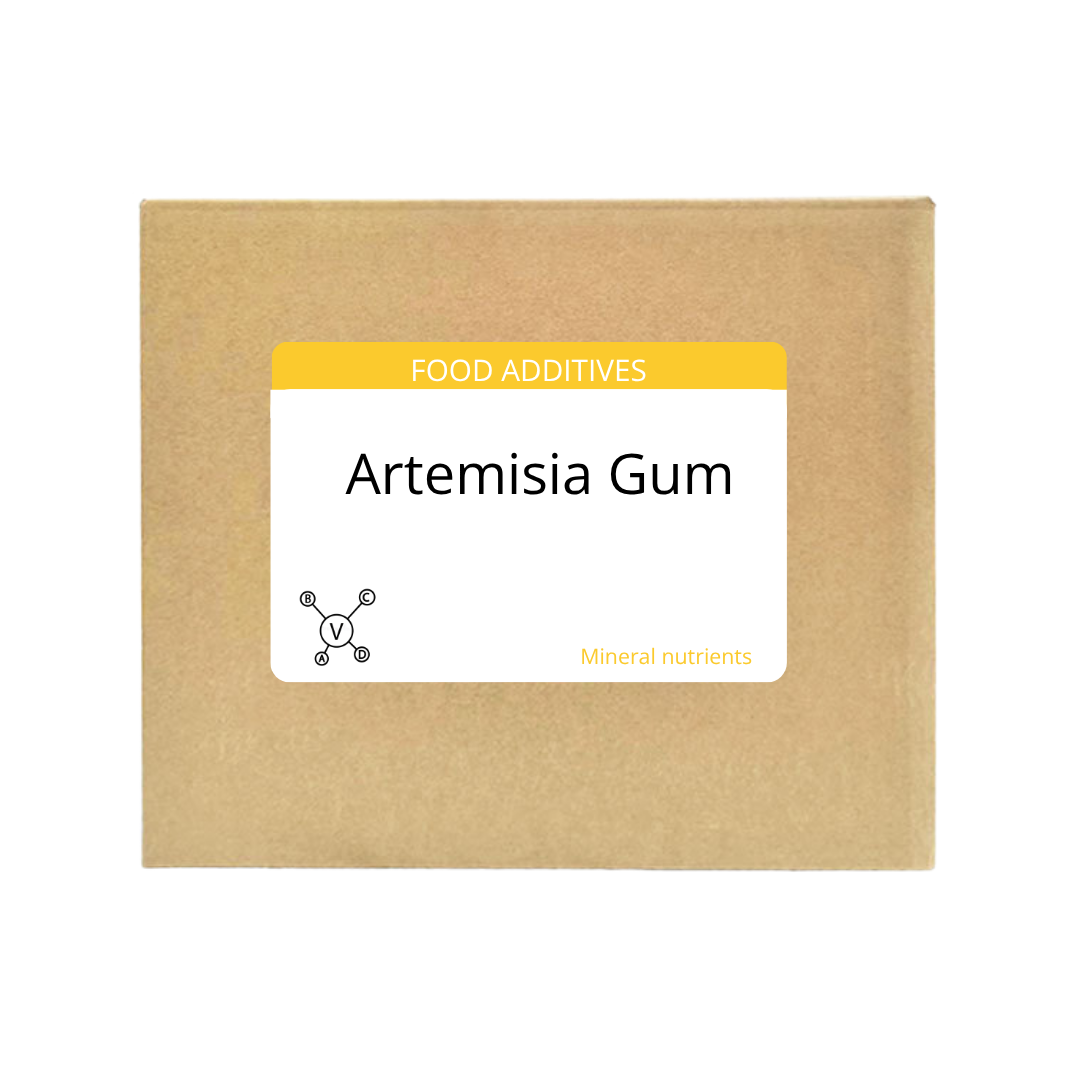
Artemisia gum is mainly derived from the artemisia annua plant, it can also be produced through microbial fermentation, offering a plant-based alternative to traditional gums, like gum tragacanth [1]. It serves as a thickening, emulsifying, and stabilizing agent in various applications [2]. This gum consists primarily of polysaccharides, giving it its functional properties [3]. Artemisia gum is used in food products, pharmaceuticals, and cosmetics for its ability to improve texture and stability [3].
Production Process
The production of artemisia gum typically involves extraction from the artemisia annua plant, this requires initial harvesting of the plant material [4]. The gum is then extracted using water or other solvents [4]. The extract undergoes purification and drying processes to obtain the final gum product [4]. Microbial fermentation involves culturing microorganisms that produce the gum, followed by separation and purification steps [5]. Quality control measures are implemented throughout the production process to ensure the gum meets required standards [4, 5].
Product Efficacy and Function
Artemisia gum functions as a stabilizer, enhancing the consistency and shelf life of formulations [6]. Its thickening properties improve the texture, making it useful in various food and cosmetic applications [6]. The emulsifying capability ensures the uniform dispersion of immiscible liquids [6]. It contributes to the overall quality and stability of the final product by preventing separation and maintaining desired properties [6].
Product Application Scenarios
In the food industry, artemisia gum is used in sauces, dressings, and desserts [7]. It improves the texture and stability of these products, preventing separation and maintaining a smooth consistency [7]. In the pharmaceutical industry, it acts as a binder in tablets and a stabilizer in suspensions [8]. Artemisia gum ensures the uniformity and efficacy of pharmaceutical formulations [8]. The cosmetic industry utilizes artemisia gum in creams, lotions, and masks, where it enhances texture and provides a smooth feel [9].
Packaging and Storage
Artemisia gum is typically packaged in multi-layer kraft paper bags with polyethylene liners or other suitable packaging material that prevents moisture absorption and contamination [10]. It should be stored in a cool, dry place, away from direct sunlight and heat [10]. Proper storage conditions help maintain the gum’s quality and prevent degradation [10]. The product has a shelf life of 24 months when stored correctly [10].
Citations
[1] Ćetković, G. S., et al. "Optimization of the Process of Gum Tragacanth Extraction." Food Hydrocolloids, vol. 22, no. 4, 2008, pp. 689-696.
[2] Patel, A. R., et al. "Gums as Emulsifiers and Stabilizers in Food Emulsions." Food Hydrocolloids, vol. 42, 2015, pp. 269-278.
[3] Williams, P. A., et al. "Plant Gums and Resins." Handbook of Hydrocolloids, 2nd ed., Woodhead Publishing, 2009, pp. 254-274.
[4] Kar, A. "Pharmacognosy and Pharmacobiotechnology." New Age International, 2003.
[5] Ramasamy, S., and P. P. Kumar. "Microbial Production of Exopolysaccharides: A Review." Journal of Polymers and the Environment, vol. 13, no. 4, 2005, pp. 345-357.
[6] Dickinson, E. "Hydrocolloids at Interfaces and in Emulsions: Recent Developments." Food Hydrocolloids, vol. 17, no. 1, 2003, pp. 25-39.
[7] Whistler, R. L., and J. N. BeMiller. "Carbohydrate Chemistry for Food Scientists." Eagan Press, 1997.
[8] Staniforth, J. "Pharmaceutical Powder Compaction Technology." CRC Press, 2008.
[9] Draelos, Z. D. "Cosmetics in Dermatology." 3rd ed., Elsevier, 2016.
[10] Wypych, G. "Handbook of Polymers." ChemTec Publishing, 2012.

As the plant manager, I focus on the precise formulation and efficient production of food additives. We rigorously control the production process to ensure the quality and safety of each product, meeting industry standards. 🍴