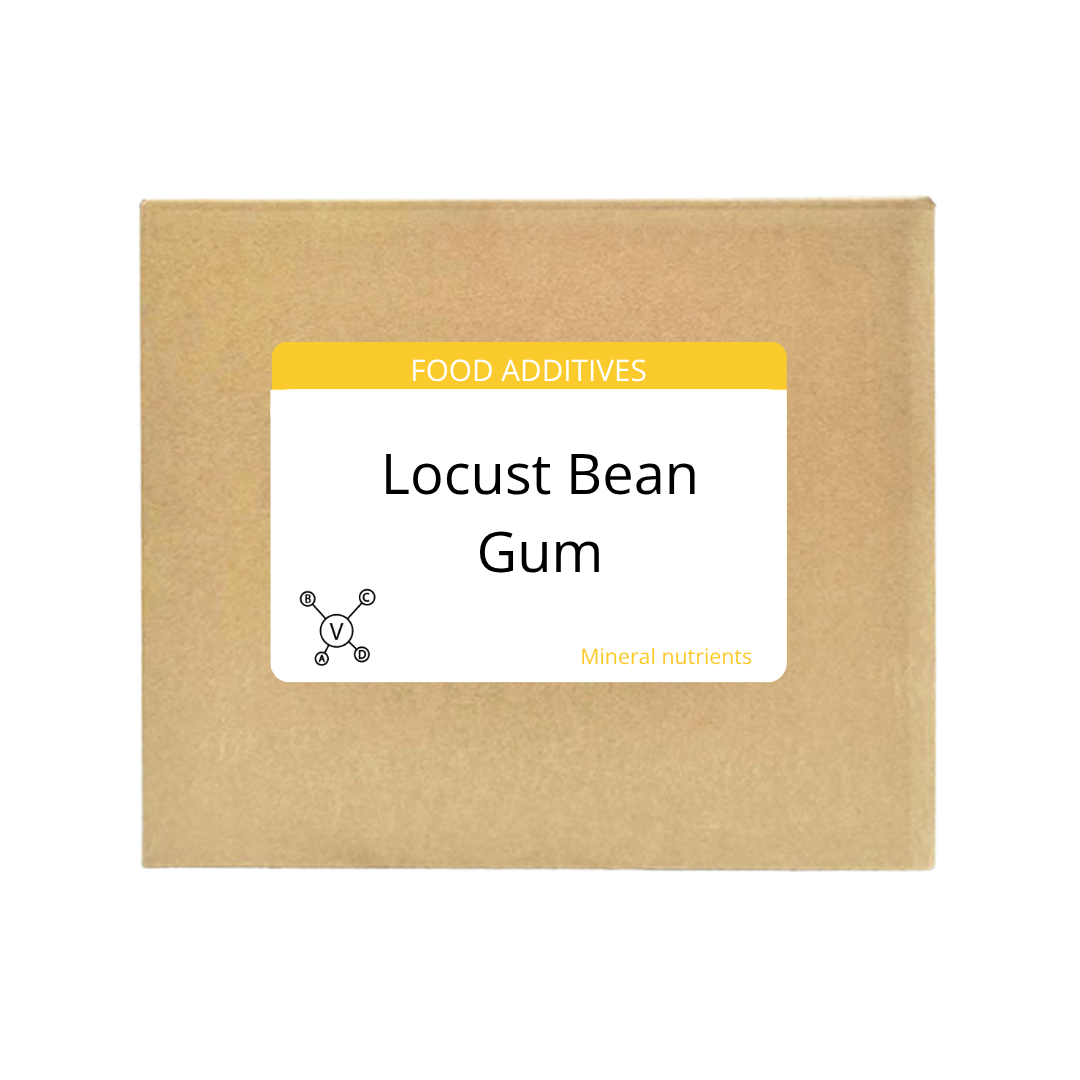


Locust bean gum, also known as carob bean gum, is a galactomannan polysaccharide derived from the seeds of the carob tree (Ceratonia siliqua). Its main components are mannose and galactose, which contribute to its thickening and gelling properties [1]. Generally, it is used in the food industry as a thickening agent, stabilizer, and emulsifier [2].
The production process of locust bean gum involves several steps. Initially, the carob seeds are milled to separate the endosperm from the seed coat and germ. The endosperm is then milled into a powder, which is locust bean gum [3]. After milling, the powder is purified and standardized to meet the required specifications for food applications.
Locust bean gum functions as a stabilizer by preventing the separation of ingredients, such as in ice cream, and as a thickener, increasing the viscosity of liquids [4]. It improves the texture and mouthfeel of food products. Additionally, it can prevent syneresis (water separation) in frozen desserts and other food items, enhancing their overall quality and shelf life [5].
Locust bean gum is used in a variety of food applications. Commonly, it is found in dairy products, like ice cream and yogurt, to improve texture and prevent ice crystal formation [6]. It is also used in bakery products to enhance dough stability and increase moisture retention [7]. In sauces and dressings, it acts as a thickening and stabilizing agent [8].
Locust bean gum is typically packaged in multi-layer paper bags or polyethylene-lined containers to protect it from moisture and contamination. It should be stored in a cool, dry environment, away from direct sunlight and heat, to maintain its quality and prevent degradation [9]. Proper storage ensures that the locust bean gum retains its functional properties throughout its shelf life.
Citations:
[1] Food and Agriculture Organization of the United Nations. (1990). Carob bean gum.
[2] EFSA Panel on Food Additives and Nutrient Sources added to Food (ANS). (2016). Scientific Opinion on the re-evaluation of locust bean gum (E 410) as a food additive. EFSA Journal, 14(7), 4546.
[3] Nussinovitch, A. (2009). Practical carbohydrate polymer analysis.
[4] Phillips, G. O., & Williams, P. A. (2009). Handbook of hydrocolloids.
[5] Dickinson, E. (2003). Emulsions and foams.
[6] Goff, H. D., & Hartel, R. W. (2013). Ice cream.
[7] Stauffer, C. E. (1999). * ময়দা উন্নতি কারক.
[8] Lásztity, R. (1995). Use of gums in the food industry.
[9] Whistler, R. L., & BeMiller, J. N. (Eds.). (2012). Food carbohydrates.

As the plant manager, I focus on the precise formulation and efficient production of food additives. We rigorously control the production process to ensure the quality and safety of each product, meeting industry standards. 🍴