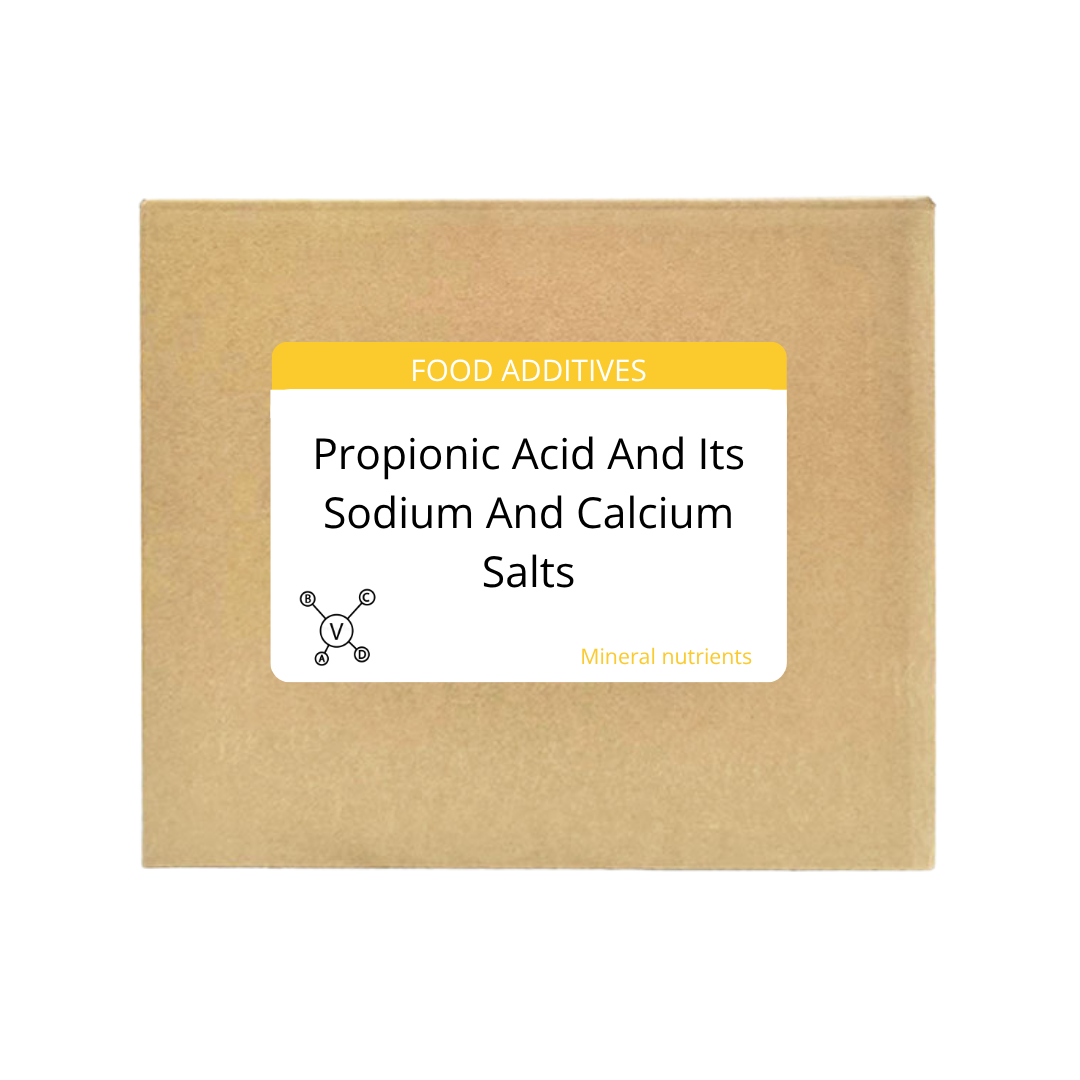


Propionic acid, a naturally occurring carboxylic acid, and its sodium and calcium salts are widely used as food preservatives. Propionic acid can be sourced from bacterial fermentation, particularly by Propionibacterium species, or synthesized chemically [1]. These compounds are effective against a variety of molds and some bacteria, making them suitable for use in baked goods, cheeses, and other processed foods [2].
Propionic acid is typically produced through the petrochemical synthesis of propionaldehyde, which is then oxidized to form propionic acid [3]. Alternatively, certain bacteria such as Propionibacterium freudenreichii can produce propionic acid via fermentation of carbohydrates [4]. Sodium and calcium salts are then produced by neutralizing propionic acid with sodium or calcium hydroxide, respectively [5].
The efficacy of propionic acid and its salts lies in their ability to inhibit microbial growth by disrupting cellular functions [6]. These additives interfere with enzyme activity and membrane transport in molds and certain bacteria, preventing them from proliferating in food products [7]. Propionic acid and its salts are most effective at low pH levels, which is why they are frequently used in slightly acidic foods [8].
Propionic acid and its corresponding salts find application across a spectrum of food products. In the baking industry, calcium propionate is frequently added to bread, cakes, and pastries to prevent mold growth and extend shelf life [9]. Cheeses, both natural and processed, also benefit from the addition of these compounds to inhibit mold and bacterial spoilage [10]. Animal feed also utilizes propionic acid and its salts to prevent spoilage and maintain nutritional value [11].
Propionic acid and its salts are generally packaged in airtight containers to prevent absorption of moisture and to maintain their stability. These materials should be stored in a cool, dry environment, away from direct sunlight and incompatible substances, to preserve their quality and effectiveness [12]. Proper storage ensures the products retain their preservative properties and prevents degradation over their designated shelf life [13].
Citations:
[1] Commission Regulation (EU) No 231/2012 laying down specifications for food additives listed in Annexes II and III to Regulation (EC) No 1333/2008 of the European Parliament and of the Council.
[2] Lück, E., & Jager, M. (1995). Antimicrobial Food Additives: Characteristics, Uses, Effects. Springer Science & Business Media.
[3] Ullmann's Encyclopedia of Industrial Chemistry. (n.d.). Wiley-VCH Verlag GmbH & Co. KGaA.
[4] Boyaval, P., & Corre, C. (1987). Propionic acid fermentation: Physiological and biochemical aspects. Lait, 67(1), 1-20.
[5] Food Chemicals Codex, 6th ed. (2008). U.S. Pharmacopeia Convention, Rockville, MD.
[6] Davidson, P. M., Sofos, J. N., & Branen, A. L. (Eds.). (2005). Antimicrobials in food. CRC press.
[7] Roe, F. J., Hodge, E. B., Lees, K. A., & Smith, T. (1965). Mode of action of propionic acid as a grain preservative. Nature, 205(4978), 1356.
[8] Sofos, J. N., & Busta, F. F. (1981). Antimicrobial activity of organic acids, esters, diacetates, and salts against Listeria monocytogenes. Journal of Food Protection, 44(9), 614-621.
[9] Smith, W. H. (2012). Lawrie's Meat Science. Elsevier.
[10] Early, R. (1998). The Technology of Dairy Products. Springer Science & Business Media.
[11] Woolford, M. K. (1975). Microbiological screening of food preservatives for silage. Journal of the Science of Food and Agriculture, 26(2), 229-237.
[12] Codex General Standard for Food Additives (GSFA) Online Database.
[13] Potter, N. N., & Hotchkiss, J. H. (1995). Food science. Springer Science & Business Media.

As the plant manager, I focus on the precise formulation and efficient production of food additives. We rigorously control the production process to ensure the quality and safety of each product, meeting industry standards. 🍴