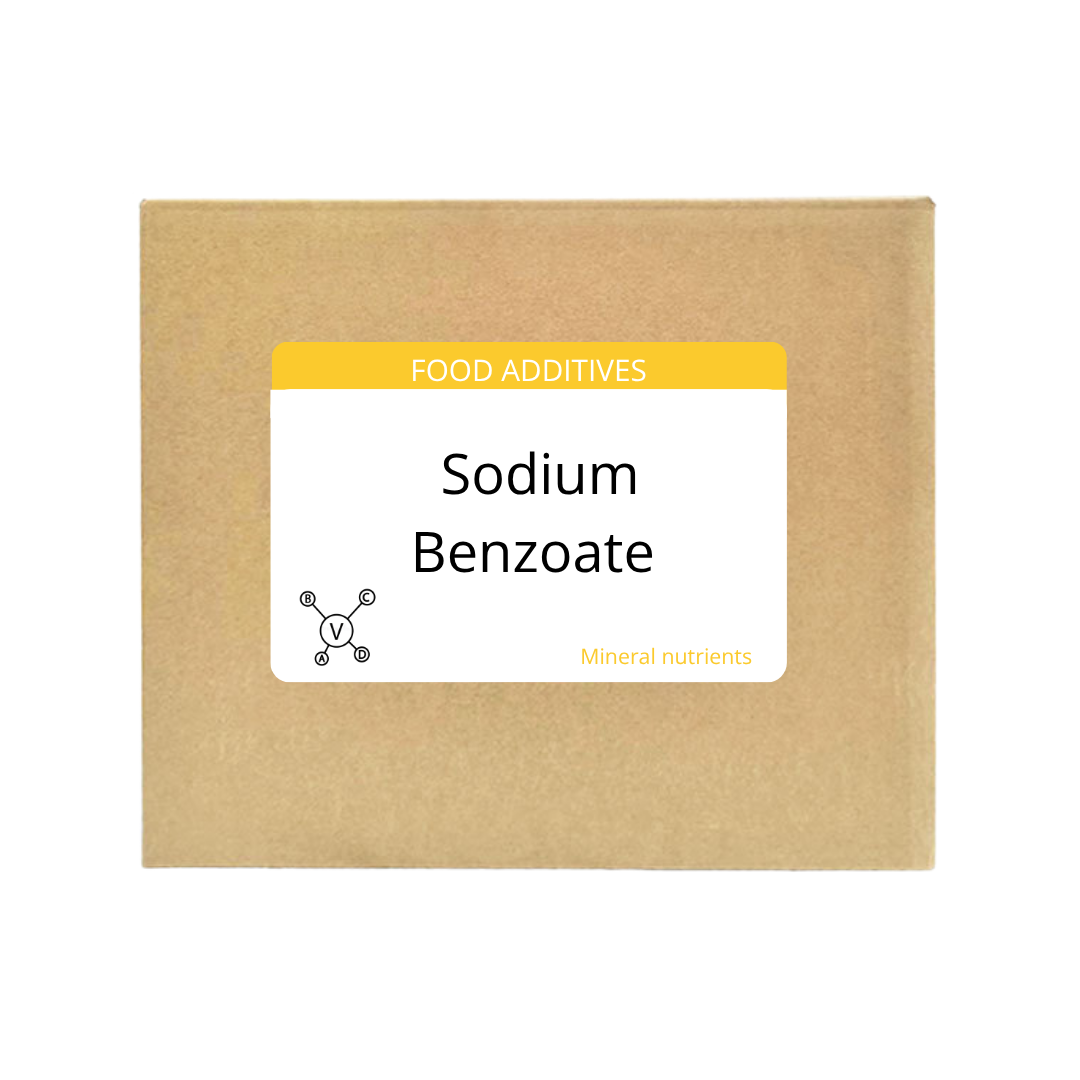


Sodium benzoate is primarily made from benzoic acid, which can be found naturally in cranberries, plums, apples, and other fruits; it is also produced synthetically by neutralizing benzoic acid with sodium hydroxide [1]. Sodium benzoate is widely used as a food preservative; it effectively inhibits the growth of bacteria, mold, and yeast in food products [2]. It is also employed in some medications and cosmetics for its preservative properties [3, 4].
The production process of sodium benzoate typically involves a reaction between benzoic acid and sodium hydroxide [5]. First, benzoic acid is dissolved in water, and then sodium hydroxide is added to the solution to neutralize the acid [6]. This reaction results in the formation of sodium benzoate and water [7]. The solution is then evaporated to obtain solid sodium benzoate, which is subsequently dried and ground into a powder or granules [8].
Sodium benzoate functions primarily as an antimicrobial preservative [9]. It works by entering microbial cells and disrupting their ability to function, preventing them from growing and multiplying [10]. This is particularly useful in acidic environments, where sodium benzoate is most effective [11]. It helps to extend the shelf life of food and cosmetic products by preventing spoilage and maintaining their quality [12].
Sodium benzoate is found in a variety of applications; it is commonly used in acidic foods and beverages, such as soft drinks, fruit juices, pickles, and salad dressings [13]. It is also utilized in the preservation of jams, jellies, and sauces [14]. Additionally, it can be found in certain pharmaceutical products, such as liquid medications, and in cosmetic products like shampoos and lotions, to prevent microbial contamination [15, 16].
Sodium benzoate is typically packaged in airtight containers to prevent moisture absorption and maintain its quality [17]. It should be stored in a cool, dry, and well-ventilated area, away from direct sunlight and incompatible substances [18]. Proper storage conditions help to extend its shelf life, ensuring its effectiveness as a preservative for up to 24 months [19].
Citations:
[1] National Center for Biotechnology Information (2024). PubChem Compound Summary for CID 517055, Sodium benzoate.
[2] Sofos, J. N. (2008). Antimicrobial agents in food. John Wiley & Sons.
[3] Rowe, R. C., Sheskey, P. J., & Quinn, M. E. (2009). Handbook of pharmaceutical excipients. Pharmaceutical Press.
[4] Fiume, M. M. (2003). Final report on the safety assessment of Benzyl Alcohol, Benzoic Acid and Sodium Benzoate. International Journal of Toxicology, 22(3_suppl), 1-30.
[5] Kirk, R. E., Othmer, D. F., Kroschwitz, J. I., & Howe-Grant, M. (1991). Encyclopedia of chemical technology. John Wiley & Sons.
[6] Salminen, S., von Wright, A., & Ouwehand, A. (2004). Lactic acid bacteria: microbiological and functional aspects. CRC press.
[7] Ullmann, F. (2007). Ullmann's encyclopedia of industrial chemistry. Wiley-VCH Verlag GmbH & Co. KGaA.
[8] Ashworth, A. J. (1991). Industrial crystallization processes. McGraw-Hill.
[9] Davidson, P. M., Sofos, J. N., & Branen, A. L. (2005). Antimicrobials in food. CRC press.
[10] Chipley, J. R. (2013). Sodium Benzoate and Benzoic Acid. Antimicrobials in Foods, 11-34.
[11] Brul, S., & Coote, P. (1999). Mechanisms of action of preservatives: the need of knowledge. International Journal of Food Microbiology, 50(1-2), 1-17.
[12] Branen, A. L., Davidson, P. M., Salminen, S., & Thorngate, J. H. (2001). Food additives. Marcel Dekker.
[13] Smith, G. A. (2012). Food preservation. Springer Science & Business Media.
[14] Potter, N. N., & Hotchkiss, J. H. (1998). Food science. Springer Science & Business Media.
[15] Elder, R. L. (1983). Final report on the safety assessment of sodium benzoate and benzoic acid. Journal of the American College of Toxicology, 2(7), 1-33.
[16] Winter, R. (2009). A consumer's dictionary of cosmetic ingredients. Potter/TenSpeed/Harmony.
[17] Marsh, K., & Bugusu, B. (2007). Food packaging—roles, materials, and environmental issues. Journal of Food Science, 72(3), R39-R55.
[18] Coles, R., McDowell, D., & Kirwan, M. J. (2003). Food packaging technology. Blackwell Publishing.
[19] Kilcast, D. (2014). Shelf life: data setting and prediction. Woodhead Publishing.

As the plant manager, I focus on the precise formulation and efficient production of food additives. We rigorously control the production process to ensure the quality and safety of each product, meeting industry standards. 🍴