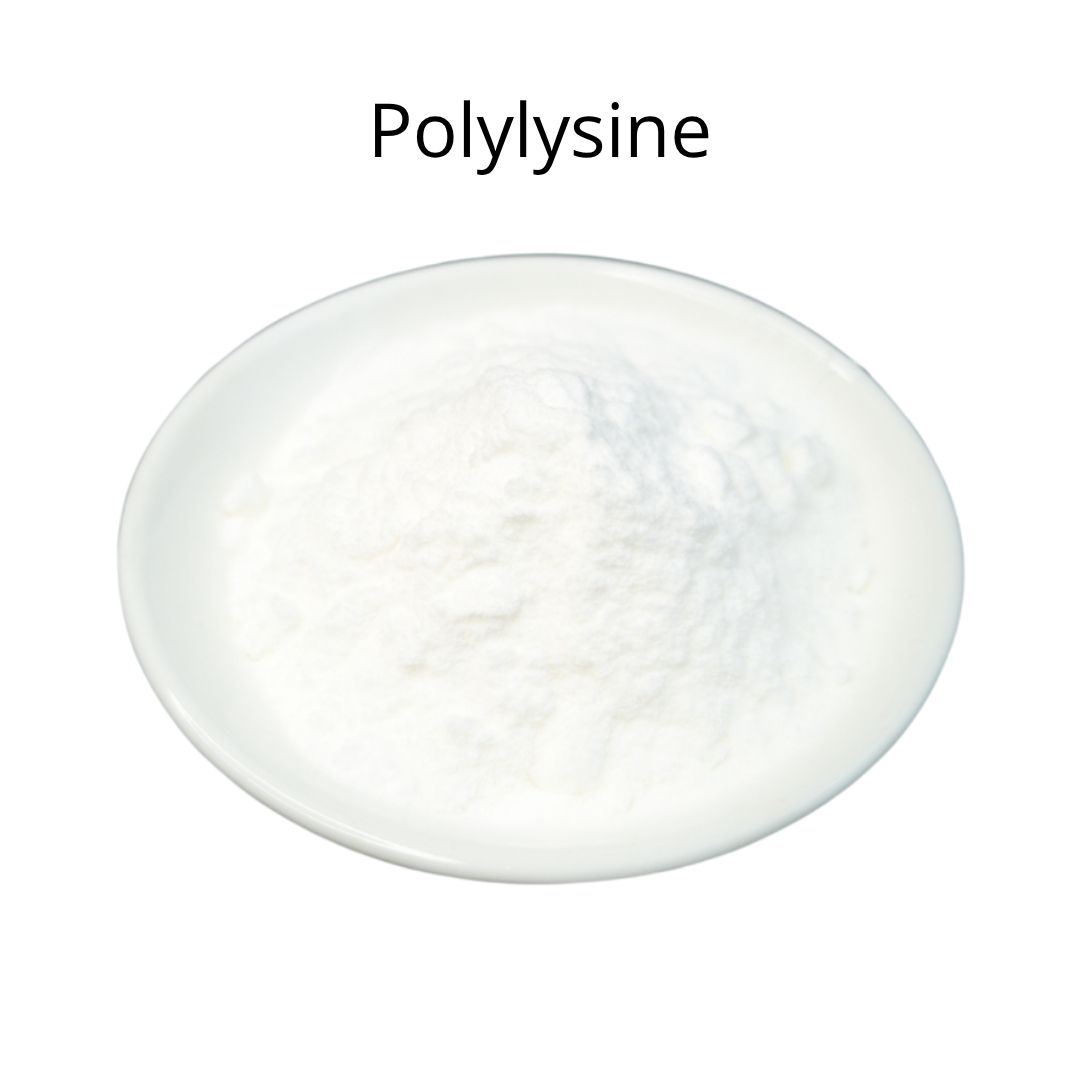


Polylysine
Alias: ε-Polylysine
CAS Number: 25988-63-0
Product Properties: This product is a homopolymer of L-lysine, produced by bacterial fermentation.
Mesh Size: 20-60 mesh
Testing Method: HPLC
Application: It is used as a natural food preservative.
Shelf Life: 2 years
Product Introduction
Polylysine, specifically ε-polylysine, is a naturally produced homo-polymer of L-lysine, typically ranging from 25 to 40 L-lysine residues [1]. It is produced through fermentation by Streptomyces strains. This cationic polypeptide exhibits antimicrobial properties, which makes it useful in various applications, primarily in the food industry [2]. Polylysine is water-soluble, biodegradable, and non-toxic, contributing to its appeal as a natural preservative [3].
Production Process
The production of polylysine mainly involves microbial fermentation. Streptomyces albulus is commonly employed for the fermentative production of ε-polylysine [4]. The process includes cultivating the bacteria in a nutrient-rich medium, optimizing conditions such as pH, temperature, and aeration to maximize polylysine yield [5]. Following fermentation, polylysine is extracted and purified from the culture broth using techniques like ion exchange chromatography or precipitation [6]. The purified polylysine is then dried and processed into a usable form.
Effects and Functions
Polylysine functions as an antimicrobial agent by disrupting the cell membranes of microorganisms. Its positive charge attracts the negatively charged microbial cell surface, leading to membrane disruption and cell death [7]. This mechanism is effective against a broad spectrum of bacteria, yeasts, and molds, making polylysine a versatile preservative [8]. Furthermore, polylysine is considered safe for human consumption, as it is readily digested by enzymes in the body [9].
Application Scenarios
Polylysine is primarily utilized in the food industry to extend the shelf life of various products. It can be applied to foods such as cooked rice, vegetables, meat products, and seafood [10]. Additionally, polylysine is used in packaging films to inhibit microbial growth on food surfaces [11]. Beyond food, polylysine has applications in cosmetics, pharmaceuticals, and as a gene transfection agent due to its cationic nature [12]. Its biocompatibility also makes it suitable for biomedical applications [13].
Packaging and Storage
Polylysine is typically packaged in airtight containers to prevent moisture absorption and maintain its stability. It should be stored in a cool, dry place away from direct sunlight and high temperatures [14]. Proper storage conditions help to ensure that polylysine retains its antimicrobial activity and remains effective throughout its shelf life [15]. Standard packaging sizes range from grams to kilograms, depending on the intended application and customer requirements.
Citations:
- Shima, S., et al. "Antimicrobial action of ε-poly-L-lysine produced by Streptomyces." Agricultural and Biological Chemistry 48.8 (1984): 1867-1870.
- Hiraki, J. "Polylysine: synthesis, properties, and applications." Bioscience and Biotechnology Biochemistry 67.6 (2003): 1175-1184.
- Ho, G. H., et al. "Biodegradable and biocompatible polymers." Polymer Degradation and Stability 98.12 (2013): 2701-2707.
- Kito, M., et al. "ε-Poly-L-lysine production by Streptomyces albulus strain no. 410." Applied Microbiology and Biotechnology 30.5 (1989): 451-456.
- Hamano, Y., et al. "Effect of aeration on ε-poly-L-lysine production by Streptomyces albulus." Journal of Fermentation Technology 64.6 (1986): 545-549.
- Fujii, T., et al. "Purification and properties of ε-poly-L-lysine produced by Streptomyces albulus." Bioscience, Biotechnology, and Biochemistry 60.9 (1996): 1478-1482.
- Lin, Y. C., et al. "Antimicrobial mechanism of polylysine." Journal of Agricultural and Food Chemistry 53.16 (2005): 6545-6552.
- Nishida, T., et al. "Effect of ε-poly-L-lysine on the growth of microorganisms." Journal of Food Protection 62.12 (1999): 1444-1448.
- O'Connell, D. W., et al. "ε-Polylysine: Applications and future trends." Trends in Food Science & Technology 66 (2017): 173-186.
- Takimoto, Y., et al. "Application of ε-poly-L-lysine to food preservation." Food Control 10.6 (1999): 461-465.
- Siriwong, S., et al. "Antimicrobial packaging film containing ε-polylysine." Journal of Food Science 72.8 (2007): M308-M315.
- Demirol, B., et al. "Polylysine: A review of chemical properties, antimicrobial activity, and potential applications." Journal of Food Science 87.6 (2022): 2253-2265.
- Yang, X., et al. "Polylysine-based biomaterials: synthesis, modification and biomedical applications." Chemical Society Reviews 44.14 (2015): 4531-4543.
- Product Data Sheet, Handary. "ε-Polylysine".
- Zhang, Z., et al. "Stability and antimicrobial activity of ε-polylysine under different storage conditions." LWT - Food Science and Technology 54.1 (2013): 202-207.

As the plant manager, I focus on the precise formulation and efficient production of food additives. We rigorously control the production process to ensure the quality and safety of each product, meeting industry standards. 🍴